

CIFAR-10 Image Dataset:
Computer Vision's Classic Benchmark
A classic image classification dataset released by Alex Krizhevsky in 2009. 60,000 32×32 color images, 10 categories—compact, efficient, and comprehensive, making it an ideal starting point for learning computer vision and deep learning.
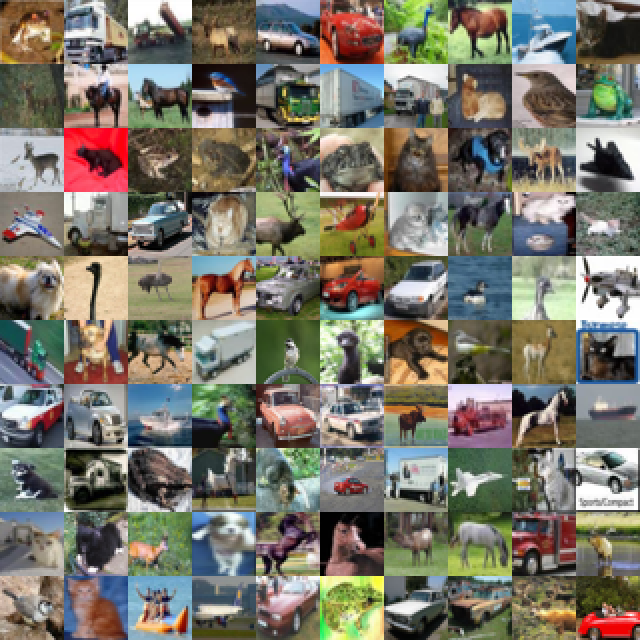
Dataset Highlights
There are good reasons why CIFAR-10 has become the standard benchmark in computer vision
Color Images
Each image is a 32×32 pixel RGB three-channel color image, retaining rich color and texture information, suitable for convolutional neural network processing.
Ten Categories
Covering 10 mutually exclusive categories: airplane, automobile, bird, cat, deer, dog, frog, horse, ship, and truck, with 6,000 images per category, balanced across categories.
Standard Split
The official standard split provides 50,000 training images and 10,000 testing images, facilitating fair comparisons of different models' performance.
Academic Benchmark
One of the most classic benchmark datasets in the field of computer vision, cited by tens of thousands of papers, and the preferred standard for validating new algorithms.
Framework Support
Mainstream deep learning frameworks such as PyTorch, TensorFlow, and Keras have native built-in support, allowing for loading and usage with a single line of code.
Lightweight and Efficient
Compared to large-scale datasets like ImageNet, CIFAR-10 is only 163 MB, making it more suitable for small-scale experiments, rapid iteration, and teaching demonstrations.
Applicable Scenarios
From classroom experiments to cutting-edge research—common uses of the CIFAR-10 dataset
Image Classification
Training and evaluating image classification models, from simple fully connected networks to complex deep convolutional networks
CNN Architecture Research
Validating the effectiveness of novel convolutional neural network architectures (ResNet, VGG, DenseNet, etc.)
Data Augmentation Experiments
Testing the effects of data augmentation strategies such as random cropping, flipping, color jittering, Mixup, CutMix, etc.
Transfer Learning
As a base dataset for pre-training or fine-tuning, exploring the performance of knowledge transfer on small-scale data
Category Preview
10 categories of the CIFAR-10 dataset and their label numbers
Label   Class          中文名称
─────   ─────────────  ────────
  0     airplane       飞机
  1     automobile     汽车
  2     bird           鸟
  3     cat            猫
  4     deer           鹿
  5     dog            狗
  6     frog           青蛙
  7     horse          马
  8     ship           船
  9     truck          卡车
3 Steps to Get Started Quickly
From browsing to training, just a few minutes
Browse Dataset
View detailed descriptions, category definitions, and sample previews of the CIFAR-10 dataset on the Ace Data Cloud platform.
Download Data Files
One-click download of a 163 MB tar.gz compressed file to your local machine, no registration, no payment, get it immediately.
Load and Train
Load data with PyTorch or TensorFlow, build a CNN model, and start training your first image classifier.
import torch
import torch.nn as nn
import torch.optim as optim
import torchvision
import torchvision.transforms as transforms
# Data preprocessing and augmentation
transform_train = transforms.Compose([
    transforms.RandomCrop(32, padding=4),
    transforms.RandomHorizontalFlip(),
    transforms.ToTensor(),
    transforms.Normalize((0.4914, 0.4822, 0.4465), (0.2470, 0.2435, 0.2616))
])
transform_test = transforms.Compose([
    transforms.ToTensor(),
    transforms.Normalize((0.4914, 0.4822, 0.4465), (0.2470, 0.2435, 0.2616))
])
# Load CIFAR-10 dataset
trainset = torchvision.datasets.CIFAR10(
    root="./data", train=True, download=True, transform=transform_train
)
trainloader = torch.utils.data.DataLoader(trainset, batch_size=128, shuffle=True)
testset = torchvision.datasets.CIFAR10(
    root="./data", train=False, download=True, transform=transform_test
)
testloader = torch.utils.data.DataLoader(testset, batch_size=100, shuffle=False)
# Define simple CNN model
class SimpleCNN(nn.Module):
    def __init__(self):
        super().__init__()
        self.features = nn.Sequential(
            nn.Conv2d(3, 32, 3, padding=1), nn.ReLU(), nn.MaxPool2d(2),
            nn.Conv2d(32, 64, 3, padding=1), nn.ReLU(), nn.MaxPool2d(2),
            nn.Conv2d(64, 128, 3, padding=1), nn.ReLU(), nn.MaxPool2d(2),
        )
        self.classifier = nn.Sequential(
            nn.Linear(128 * 4 * 4, 256), nn.ReLU(), nn.Dropout(0.5),
            nn.Linear(256, 10)
        )
    def forward(self, x):
        x = self.features(x)
        x = x.view(x.size(0), -1)
        x = self.classifier(x)
        return x
# Initialize model, loss function, and optimizer
device = torch.device("cuda" if torch.cuda.is_available() else "cpu")
model = SimpleCNN().to(device)
criterion = nn.CrossEntropyLoss()
optimizer = optim.Adam(model.parameters(), lr=0.001)
# Train model
for epoch in range(10):
    model.train()
    running_loss = 0.0
    for images, labels in trainloader:
        images, labels = images.to(device), labels.to(device)
        optimizer.zero_grad()
        outputs = model(images)
        loss = criterion(outputs, labels)
        loss.backward()
        optimizer.step()
        running_loss += loss.item()
    print(f"Epoch {epoch+1}/10, Loss: {running_loss/len(trainloader):.4f}")
# Evaluate model
model.eval()
correct, total = 0, 0
with torch.no_grad():
    for images, labels in testloader:
        images, labels = images.to(device), labels.to(device)
        outputs = model(images)
        _, predicted = torch.max(outputs, 1)
        total += labels.size(0)
        correct += (predicted == labels).sum().item()
print(f"Test Accuracy: {100 * correct / total:.2f}%")
Start Your Journey in Computer Vision
The CIFAR-10 dataset is a classic starting point for millions of researchers and developers around the world to learn computer vision. Download for free and start exploring now.