

Claude Messages API Application and Usage
Anthropic Claude is a very powerful AI conversational system. Simply enter a prompt, and it can generate fluent and natural responses in just a few seconds. Claude Messages API is Anthropic's official native API format. Unlike the OpenAI-compatible format (Chat Completion), it uses Anthropic's own request and response structure, enabling better use of Claude's unique capabilities, such as multimodal content input, tool calling, extended thinking, and other advanced features.
This document mainly introduces the usage process of Claude Messages API operations. With it, we can use native interfaces consistent with Anthropic's official ones to call Claude's conversational capabilities.
¶ Application Process
To use Claude Messages API, first go to the 胖狐中转 Console to obtain your API Token and keep it for later use.
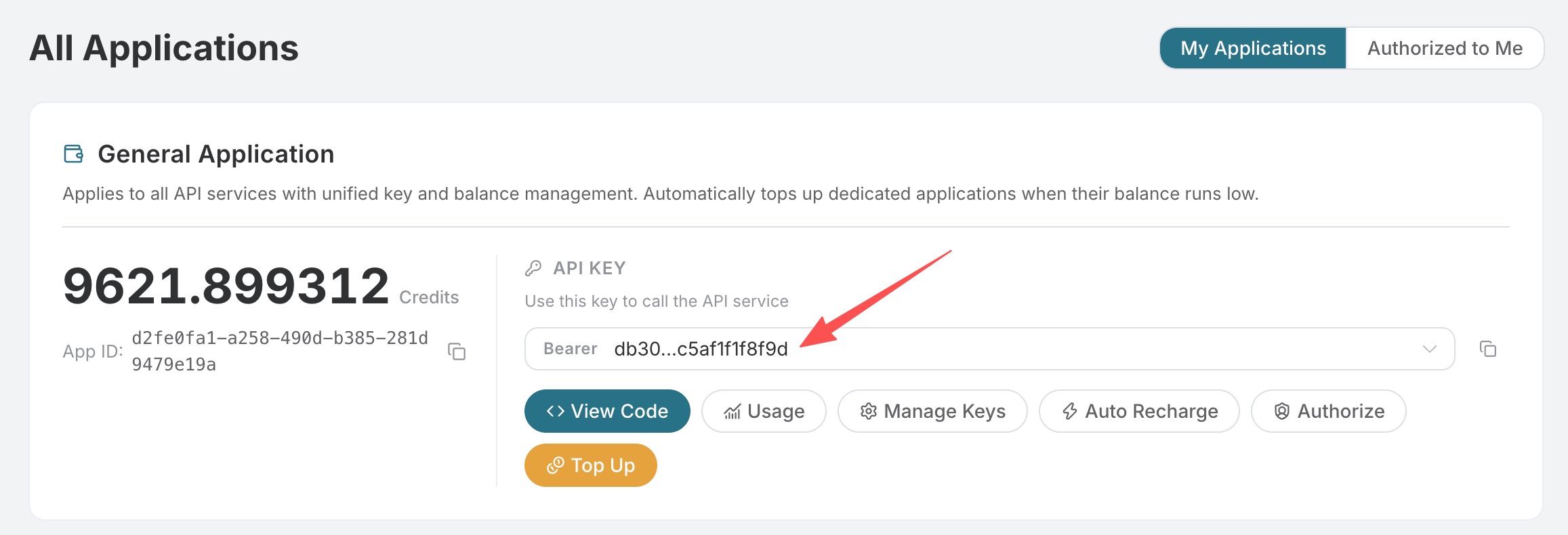
If you have not yet logged in or registered, you will be automatically redirected to the login page and invited to register and log in. After completion, you will automatically return to the current page.
One API Token can call all platform services; there is no need to apply separately for each service. Your first application includes free credits for a free trial; when credits are insufficient, you can recharge your general balance in the Console.
📘 Full documentation: Claude Messages API →
¶ Basic Usage
The request path for Claude Messages API is /v1/messages, consistent with Anthropic's official API. We need to provide at least three required parameters:
model: Select the Claude model to use.claude-opus-5-5is available only through the Messages API, supports 1 million Token context and a maximum output of 128K Tokens, and always enables adaptive thinking. The latest flagship isclaude-fable-5-1(1 million Token context, maximum output of 128K Tokens); the originalclaude-fable-5remains supported for compatibility.claude-sonnet-5-5has joined the native Messages series interface, supporting image input and adaptive thinking; its official reference prices for input, output, and cache reads are $2, $10, and $0.20 per million Tokens, respectively.messages: An array of input messages. Each message containsrole(role) andcontent(content), whererolesupportsuserandassistant.max_tokens: The maximum number of output tokens, used to limit the length of a single response.
Common optional parameters:
system: System prompt, used to define the model's behavior and role.temperature: Generation randomness, between 0 and 1. The larger the value, the more divergent the response.stream: Whether to use streaming responses. Setting it totrueenables a word-by-word return effect.stop_sequences: Custom stop sequences. The model stops generating when it encounters these texts.top_p: Nucleus sampling parameter, used with temperature to control generation randomness.top_k: Sample only from the K options with the highest probabilities.tools: Tool definitions, used to allow the model to call external functions.tool_choice: Controls how the model uses the provided tools.cache_control: Automatically creates a cache breakpoint at the last cacheable content block of the request; it can also be written on a specific content block.
¶ cURL Example
curl -X POST 'https://api.ace.324567.xyz/v1/messages' \
  -H 'accept: application/json' \
  -H 'authorization: Bearer {token}' \
  -H 'content-type: application/json' \
  -d '{
    "model": "claude-fable-5-1",
    "max_tokens": 1024,
    "messages": [
      {
        "role": "user",
        "content": "Hello, Claude"
      }
    ]
  }'
¶ Python Example
import requests

url = "https://api.ace.324567.xyz/v1/messages"

headers = {
    "accept": "application/json",
    "authorization": "Bearer {token}",
    "content-type": "application/json"
}

payload = {
    "model": "claude-fable-5-1",
    "max_tokens": 1024,
    "messages": [
        {"role": "user", "content": "Hello, Claude"}
    ]
}

response = requests.post(url, json=payload, headers=headers)
print(response.json())
After calling it, the returned result is as follows:
{
  "id": "msg_013Zva2CMHLNnXjNJJKqJ2EF",
  "type": "message",
  "role": "assistant",
  "content": [
    {
      "type": "text",
      "text": "Hi! My name is Claude. How can I help you today?"
    }
  ],
  "model": "claude-opus-4-8",
  "stop_reason": "end_turn",
  "stop_sequence": null,
  "usage": {
    "input_tokens": 12,
    "output_tokens": 15
  }
}
Description of returned result fields:
id: The unique identifier of this message.type: Alwaysmessage.role: Alwaysassistant.content: An array of response content. Each element containstype(such astext) and the corresponding content.model: The name of the model that processed the request.stop_reason: The reason for stopping. Stable values includeend_turn,max_tokens,stop_sequence,tool_use,pause_turn(the current assistant content can be returned as-is to continue),refusal, andmodel_context_window_exceeded.stop_sequence: If stopped due to a custom stop sequence, displays the matched stop sequence text.stop_details: Whenstop_reasonisrefusal, it may contain the refusal category and description.usage: Token usage statistics.input_tokensare uncached inputs;cache_creation_input_tokensandcache_read_input_tokensare cache writes and reads respectively;output_tokensis the total number of output tokens. Ifoutput_tokens_details.thinking_tokensis returned, this value is a subset ofoutput_tokens; do not add it again when calculating totals or costs. This detail may benullor omitted when no authoritative count is available.usage.cache_creation: Optional cache write TTL details, containingephemeral_5m_input_tokensandephemeral_1h_input_tokens. When the object exists, the sum of the two equalscache_creation_input_tokens; a field beingnullor omitted indicates that no TTL breakdown is available for the current response and must not be interpreted as0.usage.cost: Non-streaming responses may contain a credit consumption object recorded by 胖狐中转, whereamountis the actual consumption for this request,currencyis the unit of measurement, andlist_amountis the amount before discounts (if any). The official base price for Fable 5.1 cache reads is $0.25 per million Tokens, while the base prices for 5-minute and 1-hour cache writes are $12.50 and $20 per million Tokens, respectively; actual platform prices are converted based on plan discounts.
¶ System Prompts
Claude Messages API supports setting system prompts through the system field, used to define the model's behavior, role, and context.
¶ Python Example
import requests

url = "https://api.ace.324567.xyz/v1/messages"

headers = {
    "accept": "application/json",
    "authorization": "Bearer {token}",
    "content-type": "application/json"
}

payload = {
    "model": "claude-sonnet-4-20250514",
    "max_tokens": 1024,
    "system": "你是一位专业的中文翻译助手,请将用户输入的英文翻译成中文。",
    "messages": [
        {"role": "user", "content": "The quick brown fox jumps over the lazy dog."}
    ]
}

response = requests.post(url, json=payload, headers=headers)
print(response.json())
By setting the system prompt, you can precisely control Claude's role and behavior.
¶ Streaming Responses
This API also supports streaming responses. Set the stream parameter to true to receive results progressively, which is very suitable for implementing word-by-word display on web pages.
¶ Python Example
import requests

url = "https://api.ace.324567.xyz/v1/messages"

headers = {
    "accept": "application/json",
    "authorization": "Bearer {token}",
    "content-type": "application/json"
}

payload = {
    "model": "claude-sonnet-4-20250514",
    "max_tokens": 1024,
    "stream": True,
    "messages": [
        {"role": "user", "content": "Hello, Claude"}
    ]
}

response = requests.post(url, json=payload, headers=headers, stream=True)
for line in response.iter_lines():
    if line:
        print(line.decode("utf-8"))
Streaming responses are returned in Server-Sent Events (SSE) format, with each line prefixed by event: and data:. Streaming event types include:
message_start: The message starts, containing the basic information of the message and the model name.content_block_start: A content block starts.content_block_delta: An incremental update to a content block, containing newly generated text fragments.content_block_stop: A content block ends.message_delta: An incremental update at the message level, containingstop_reasonand finalusageinformation. The authoritative value ofoutput_tokens_details.thinking_tokensshould only be read from the finalmessage_delta.usage; do not accumulate it across events.message_stop: The message ends.
The output is as follows:
event: message_start
data: {"type":"message_start","message":{"id":"msg_01XFDUDYJgAACzvnptvVoYEL","type":"message","role":"assistant","content":[],"model":"claude-sonnet-4-20250514","stop_reason":null,"stop_sequence":null,"usage":{"input_tokens":12,"output_tokens":0}}}

event: content_block_start
data: {"type":"content_block_start","index":0,"content_block":{"type":"text","text":""}}

event: content_block_delta
data: {"type":"content_block_delta","index":0,"delta":{"type":"text_delta","text":"Hi"}}

event: content_block_delta
data: {"type":"content_block_delta","index":0,"delta":{"type":"text_delta","text":"! My name is"}}

event: content_block_delta
data: {"type":"content_block_delta","index":0,"delta":{"type":"text_delta","text":" Claude. How can I help you today?"}}

event: content_block_stop
data: {"type":"content_block_stop","index":0}

event: message_delta
data: {"type":"message_delta","delta":{"stop_reason":"end_turn","stop_sequence":null},"usage":{"output_tokens":15}}

event: message_stop
data: {"type":"message_stop"}
As you can see, the content_block_delta event in the streaming response contains progressively generated text content. By concatenating all text_delta values, you can obtain the complete reply.
¶ JavaScript Example
const options = {
  method: "POST",
  headers: {
    accept: "application/json",
    authorization: "Bearer {token}",
    "content-type": "application/json",
  },
  body: JSON.stringify({
    model: "claude-sonnet-4-20250514",
    max_tokens: 1024,
    stream: true,
    messages: [{ role: "user", content: "Hello, Claude" }],
  }),
};

const response = await fetch("https://api.ace.324567.xyz/v1/messages", options);
const reader = response.body.getReader();
const decoder = new TextDecoder();

while (true) {
  const { done, value } = await reader.read();
  if (done) break;
  console.log(decoder.decode(value));
}
¶ Multi-turn Conversations
If you want to integrate multi-turn conversation functionality, you need to alternately arrange messages with the user and assistant roles in the messages array and pass in the previous conversation history together.
¶ Python Example
import requests

url = "https://api.ace.324567.xyz/v1/messages"

headers = {
    "accept": "application/json",
    "authorization": "Bearer {token}",
    "content-type": "application/json"
}

payload = {
    "model": "claude-sonnet-4-20250514",
    "max_tokens": 1024,
    "messages": [
        {"role": "user", "content": "Hello, my name is Alice."},
        {"role": "assistant", "content": "Hello Alice! Nice to meet you. How can I help you today?"},
        {"role": "user", "content": "What is my name?"}
    ]
}

response = requests.post(url, json=payload, headers=headers)
print(response.json())
The returned result is as follows:
{
  "id": "msg_01Y1wfQmd89g968TVbFu57Yc",
  "type": "message",
  "role": "assistant",
  "content": [
    {
      "type": "text",
      "text": "Your name is Alice, as you just told me!"
    }
  ],
  "model": "claude-sonnet-4-20250514",
  "stop_reason": "end_turn",
  "stop_sequence": null,
  "usage": {
    "input_tokens": 40,
    "output_tokens": 14
  }
}
By passing the complete conversation history in messages, Claude can provide accurate answers based on the context.
¶ Deep Thinking Models
Claude's thinking and thinking summary are two different concepts: the model can perform internal reasoning, but the API does not return the original chain of thought. When the reasoning process needs to be displayed, the API returns a processed summary.
Current models are recommended to use adaptive thinking, with the overall reasoning effort controlled through output_config.effort:
import requests

url = "https://api.ace.324567.xyz/v1/messages"
headers = {
    "accept": "application/json",
    "authorization": "Bearer {token}",
    "content-type": "application/json"
}
payload = {
    "model": "claude-opus-5",
    "max_tokens": 16000,
    "thinking": {
        "type": "adaptive",
        "display": "summarized"
    },
    "output_config": {
        "effort": "high"
    },
    "messages": [
        {"role": "user", "content": "What is the sine of 30 degrees?"}
    ]
}

response = requests.post(url, json=payload, headers=headers)
print(response.json())
The thinking block in the response takes the following form:
{
  "type": "thinking",
  "thinking": "The problem asks for a standard trigonometric value...",
  "signature": "opaque-signature"
}
display: "summarized"returns a readable summary of thinking; it is not the original chain of thought.display: "omitted"returnsthinking: "", but still retains the opaquesignatureto support subsequent conversations.- The default display value for Fable 5.1, Fable 5, Opus 5, Sonnet 5, Opus 4.8, and Opus 4.7 is
omitted; models that support thinking from Opus 4.6, Sonnet 4.6, and earlier usesummarizedby default. - Display only affects returned content and streaming latency; it does not disable reasoning or reduce billing for thinking tokens.
- Whether thinking is enabled by default and the display default value are two independent questions. Opus 5 and Sonnet 5 enable adaptive thinking by default; for Opus 5, omitting
thinkingis equivalent to adaptive, and omittingoutput_config.effortis equivalent tohigh. Opus 4.8, 4.7, and 4.6 require explicit enablement. - Thinking and the final body jointly consume the
max_tokensoutput budget. When the budget is too small, thinking may consume most of the quota, leaving the body empty or truncated; increasemax_tokens, or uselow/mediumeffort to control reasoning investment. - For models that allow thinking to be disabled, you can pass
thinking: {"type":"disabled"}; disabled can only be used withlow,medium, orhigh, whilexhigh/maxwill return 400. budget_tokensis only used for older models that still support a fixed thinking budget. New models should usethinking.type=adaptiveandoutput_config.effort; thinking is always enabled for Fable 5.1 and cannot be explicitly disabled.- During multi-turn conversations and tool calls, the complete thinking block and signature returned by the assistant should be passed back unchanged; do not modify or generate the signature yourself.
- Some compatibility routes cannot losslessly handle
redacted_thinkingor explicitly disabling thinking. In this case, they return a parameter error instead of silently dropping or changing the request semantics.
In streaming requests, summarized produces thinking_delta; omitted does not produce thinking_delta, retaining only the thinking block lifecycle and signature_delta.
¶ Vision Models
Claude supports multimodal input and can process text and images simultaneously. In the Messages API, vision capabilities can be used by setting content to an array format and passing image content blocks.
¶ Using Base64-Encoded Images
import base64
import requests

url = "https://api.ace.324567.xyz/v1/messages"

headers = {
    "accept": "application/json",
    "authorization": "Bearer {token}",
    "content-type": "application/json"
}

# 读取并编码图片
with open("image.png", "rb") as f:
    image_data = base64.standard_b64encode(f.read()).decode("utf-8")

payload = {
    "model": "claude-sonnet-4-20250514",
    "max_tokens": 1024,
    "messages": [
        {
            "role": "user",
            "content": [
                {
                    "type": "image",
                    "source": {
                        "type": "base64",
                        "media_type": "image/png",
                        "data": image_data
                    }
                },
                {
                    "type": "text",
                    "text": "What's in this image?"
                }
            ]
        }
    ]
}

response = requests.post(url, json=payload, headers=headers)
print(response.json())
¶ Using URL Images
import requests

url = "https://api.ace.324567.xyz/v1/messages"

headers = {
    "accept": "application/json",
    "authorization": "Bearer {token}",
    "content-type": "application/json"
}

payload = {
    "model": "claude-sonnet-4-20250514",
    "max_tokens": 1024,
    "messages": [
        {
            "role": "user",
            "content": [
                {
                    "type": "image",
                    "source": {
                        "type": "url",
                        "url": "https://cdn.acedata.cloud/ueugot.png"
                    }
                },
                {
                    "type": "text",
                    "text": "What's in this image?"
                }
            ]
        }
    ]
}

response = requests.post(url, json=payload, headers=headers)
print(response.json())
¶ cURL Example
curl -X POST 'https://api.ace.324567.xyz/v1/messages' \
  -H 'accept: application/json' \
  -H 'authorization: Bearer {token}' \
  -H 'content-type: application/json' \
  -d '{
    "model": "claude-sonnet-4-20250514",
    "max_tokens": 1024,
    "messages": [
      {
        "role": "user",
        "content": [
          {
            "type": "image",
            "source": {
              "type": "url",
              "url": "https://cdn.acedata.cloud/ueugot.png"
            }
          },
          {
            "type": "text",
            "text": "What'\''s in this image?"
          }
        ]
      }
    ]
  }'
Supported image formats include: image/jpeg, image/png, image/gif, and image/webp.
¶ Documents and PDFs
PDFs use document content blocks and support two stable sources: Base64 and URL. Base64 sources must use application/pdf:
import base64

with open("report.pdf", "rb") as f:
    pdf_data = base64.standard_b64encode(f.read()).decode("utf-8")

payload = {
    "model": "claude-fable-5-1",
    "max_tokens": 1024,
    "messages": [{
        "role": "user",
        "content": [
            {
                "type": "document",
                "source": {
                    "type": "base64",
                    "media_type": "application/pdf",
                    "data": pdf_data
                },
                "title": "Quarterly report"
            },
            {"type": "text", "text": "Summarize this PDF."}
        ]
    }]
}
URL sources are written as {"type":"url","url":"https://example.com/report.pdf"}. document also supports text/plain and content sources composed of text/image blocks; optional fields include title, context, and citations. The Files API file_id source is an independent beta feature and is not part of the stable contract of this interface.
¶ Prompt Caching
Top-level cache_control automatically places the cache breakpoint on the last cacheable block:
payload = {
    "model": "claude-fable-5-1",
    "max_tokens": 1024,
    "cache_control": {"type": "ephemeral", "ttl": "5m"},
    "system": "You are an expert on this reference material.",
    "messages": [{"role": "user", "content": "Summarize the key points."}]
}
When precise position control is needed, the same cache_control can also be written on text, image, document, tool_use, tool_result content blocks, or tool definitions. ttl supports 5m (default) and 1h; use usage.cache_creation_input_tokens and usage.cache_read_input_tokens to determine cache writes and hits.
When the response provides usage.cache_creation, ephemeral_5m_input_tokens + ephemeral_1h_input_tokens = cache_creation_input_tokens. If cache_creation is null or omitted, it means that only the total cache write amount is available, without an authoritative TTL breakdown; in this case, do not treat either bucket as a known 0, and billing and totals should still be based on the aggregate field.
Returned result example:
{
  "id": "msg_01NCrxpZmV17bhQJJRQEFEb9",
  "type": "message",
  "role": "assistant",
  "content": [
    {
      "type": "text",
      "text": "This image shows an API request configuration interface for what appears to be an AI chat completion service. The interface includes parameters for model selection, messages, stream mode, and max tokens settings."
    }
  ],
  "model": "claude-sonnet-4-20250514",
  "stop_reason": "end_turn",
  "stop_sequence": null,
  "usage": {
    "input_tokens": 1570,
    "output_tokens": 52
  }
}
¶ Tool Use
The Claude Messages API natively supports tool use, allowing the model to call your predefined tools/functions when needed.
¶ Python Example
import requests

url = "https://api.ace.324567.xyz/v1/messages"

headers = {
    "accept": "application/json",
    "authorization": "Bearer {token}",
    "content-type": "application/json"
}

payload = {
    "model": "claude-sonnet-4-20250514",
    "max_tokens": 1024,
    "tools": [
        {
            "name": "get_weather",
            "description": "Get the current weather in a given location",
            "input_schema": {
                "type": "object",
                "properties": {
                    "location": {
                        "type": "string",
                        "description": "The city and state, e.g. San Francisco, CA"
                    }
                },
                "required": ["location"]
            }
        }
    ],
    "messages": [
        {"role": "user", "content": "What's the weather like in San Francisco?"}
    ]
}

response = requests.post(url, json=payload, headers=headers)
print(response.json())
When the model decides to call a tool, the returned result's content will include a content block of the tool_use type:
{
  "id": "msg_01Aq9w938a90dw8q",
  "type": "message",
  "role": "assistant",
  "content": [
    {
      "type": "text",
      "text": "Let me check the weather in San Francisco for you."
    },
    {
      "type": "tool_use",
      "id": "toolu_01A09q90qw90lq917835lgs",
      "name": "get_weather",
      "input": {
        "location": "San Francisco, CA"
      }
    }
  ],
  "model": "claude-sonnet-4-20250514",
  "stop_reason": "tool_use",
  "stop_sequence": null,
  "usage": {
    "input_tokens": 120,
    "output_tokens": 68
  }
}
Note that stop_reason is tool_use, indicating that the model needs to call a tool. After receiving this result, you need to execute the tool function and return the result to the model in the form of tool_result:
payload = {
    "model": "claude-sonnet-4-20250514",
    "max_tokens": 1024,
    "tools": [
        {
            "name": "get_weather",
            "description": "Get the current weather in a given location",
            "input_schema": {
                "type": "object",
                "properties": {
                    "location": {
                        "type": "string",
                        "description": "The city and state, e.g. San Francisco, CA"
                    }
                },
                "required": ["location"]
            }
        }
    ],
    "messages": [
        {"role": "user", "content": "What's the weather like in San Francisco?"},
        {
            "role": "assistant",
            "content": [
                {"type": "text", "text": "Let me check the weather in San Francisco for you."},
                {"type": "tool_use", "id": "toolu_01A09q90qw90lq917835lgs", "name": "get_weather", "input": {"location": "San Francisco, CA"}}
            ]
        },
        {
            "role": "user",
            "content": [
                {
                    "type": "tool_result",
                    "tool_use_id": "toolu_01A09q90qw90lq917835lgs",
                    "content": "Sunny, 72°F"
                }
            ]
        }
    ]
}

response = requests.post(url, json=payload, headers=headers)
print(response.json())
The model will generate the final natural language response based on the result returned by the tool.
¶ Differences from the Chat Completion API
胖狐中转 provides two Claude API formats at the same time. The main differences between them are as follows:
For the Messages API, usage.input_tokens only represents uncached input, while cache_read_input_tokens and cache_creation_input_tokens are separately billed buckets; all three are calculated separately according to their corresponding prices.
| Feature | Messages API (/v1/messages) |
Chat Completion API (/v1/chat/completions) |
|---|---|---|
| Format | Anthropic native format | OpenAI-compatible format |
| System prompt | Separate system field |
Passed through role: "system" in messages |
| Response structure | content array (supports multiple types) |
choices array (contains message) |
| Streaming format | SSE events (multiple event types) | SSE data lines |
| Extended thinking | Native thinking and output_config.effort |
Model default strategy and compatible parameters |
| Tool use | Native tools + input_schema |
OpenAI-compatible tools format |
| Token statistics | output_tokens_details.thinking_tokens |
completion_tokens_details.reasoning_tokens |
If your system has already integrated with an OpenAI-format API, you can use the Chat Completion API for seamless switching. If you need to use all of Claude's native capabilities, it is recommended to use the Messages API.
¶ Error Handling
Error responses from public APIs use the 胖狐中转 platform envelope: error.code is the stable error code, error.message is the description, and trace_id is used to troubleshoot requests. Common HTTP statuses include:
400: Request parameters or protocol content is invalid.401: The authorization token is invalid, missing, or expired.403: Access is forbidden, the balance is insufficient, or the quota is restricted.404: The API or model does not exist.413: The request body is too large.429: Too many requests.500/503/504: Service error, temporarily unavailable, or processing timeout.
¶ Error Response Example
{
  "error": {
    "code": "api_error",
    "message": "fetch failed"
  },
  "trace_id": "2cf86e86-22a4-46e1-ac2f-032c0f2a4e89"
}
This error structure is the runtime contract of 胖狐中转 and is not equivalent to Anthropic's official error envelope; please handle it according to the HTTP status and error.code.
¶ Conclusion
Through this document, you have learned how to use the Claude Messages API to call Claude's conversational capabilities in Anthropic's native format. The Messages API supports a rich range of features, including basic conversations, system prompts, streaming responses, multi-turn conversations, extended thinking, vision understanding, PDFs, prompt caching, and tool use. If you have any questions, please feel free to contact our technical support team.